HUGO VAN DER MOLEN'S
Scripophily site
a collection of historic bonds
and
shares
Muzieknotenschrift
(update: 14-3-2025)
Dr. Hugo H. van der Molen -
Tel: +31 (0)50 534 8795; email: [email protected]
en Facebook of Linkedin
Paypal accepted
See
page on explanations, sales conditions, costs of shipping and on how
to
order and to pay.
You are here: home - scripophily
- muzieknotenschrift
Muzieknotenschrift
In 1814 gaf de toen pas opgerichte Nederlandsche Bank de eerste
voorlopige bankbiljetten uit, nog zonder watermerk, maar met een voor
die tijd ingewikkelde randversiering. Men noemt deze randversiering wel
"het muziekschrift". Alhoewel
reeds in de middeleeuwen meerdere lettersnijders zich met
karakteristieke lettertypes hadden bezig gehouden, was het toch Joan
Michael Fleischmann (1701-
1768), toen al in dienst bij drukkerij Johan Enschede, die voor een
belangrijk
deel voor "Fleischmann's muziekschrift" tekende.
Tot het einde van de 18e eeuw kon men niet veel met de wonderbaarlijke
muzieknotendruk
beginnen. Omstreeks 1795 is een medewerker van Joh. Enschede gaan
experimenteren
met de door Fleischmann gesneden muziekstempels om randen voor
geldswaardig
papier samen te stellen, die niet of heel moeilijk waren na te maken.
Een
van de eerste producten was niet voor numismaten maar voor uiteindelijk
de
verzamelaars van oude effecten. In 1797 werden door het toenmalig gezag
van
het Provinciaal Bestuur van Holland certificaten uitgegeven, wat we nu
kunnen
beschouwen als de voorlopers van de huidige staatsleningen.
Buiten effecten en muntbiljetten werden ook de eerste cheques van deze
fraaie
rand voorzien.
De "Muzieknotenrand" heeft het lang volgehouden. Kwam het in 1814 op
bankbiljetten
in circulatie (eerst rondom het biljet gedrukt - voorlopige serie-)
later
alleen op de twee verticale zijkanten (1e tot en met 7e soort). De
zogenaamde
roodborstjes werden gedruk tot 1862, maar bleven in circulatie tot 2
januari
1921.
De drukker stopte voor de aanmaak van bankbiljetten het
muzieknotenschrift in dat jaar 1862 in de kast, omdat het namaken geen
onoverkomelijk probleem meer was. Er kwamen modernere en moeilijker na
te maken biljetten in omloop, maar vergeten was men het muziekschrift
zeker niet. Werden de "muziektekens" voor verdere beveiliging van
bankbiljetten ongeschikt geacht, voor effecten werd het nog vele jaren
gebruikt.
Literatuur:
----- Muzikale waardepapieren, VVOF Mededelingenblad maart 1996, p. 6-8 en 13, met 3 afb., door W.J. Nieboer
----- Spiegel van de geschiedenis, VVOF Mededelingenblad september 1980, p. 3-4, met 2 afb., door ?
Hierna volgen enkele voorbeelden:
 |
|
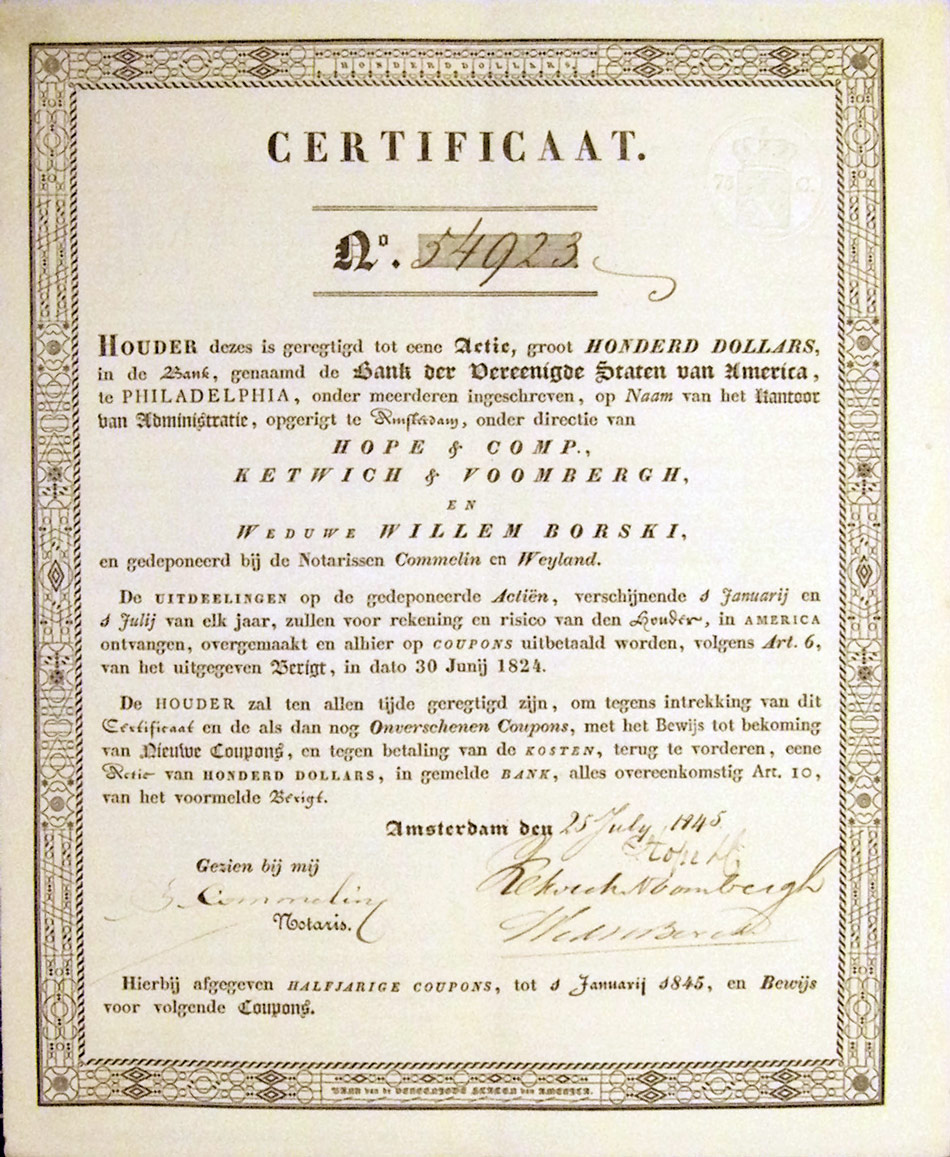
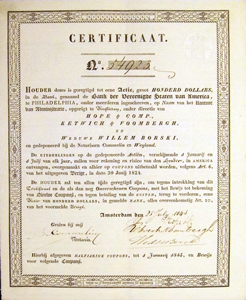
Bank der Vereenigde staten van Amerika = Bank of the United States of America:
Established in Philadelphia in 1816
Certificate in
Dutch language, issued in the years 1841 - 1852 (items available here are from 1842, 1844 and 1845) in Amsterdam against original shares of 100$ each. The
issuing bank was the very famous banking-group of Hope & Comp., Ketwich and
Voombergh and the widow of Willem Borsky.
Hope & Co. represented the Dutch or European shareholders in the US
Bank when it ran into difficulties around 1841. Just like about 50% of all the USA banks did after the Panic of 1837, related , among other factors, to a sharp decline in cotton prices after a bubble in the prices of land, slaves and cotton in the years before.
The certificates are in
condition EF, without
folds, very clean and have an
ornate border of the so called "music note" type (a type of security
print). It measures: ca. 21 x 26 cm, with separate complete coupon sheet, Price 45
Euro.
Literature (In Dutch):
- Bank der Vereenigde Staten = 6% Bank der Vereenigde Staten (Rothschild Loan), VVOF Mededelingenblad, december 1980, p. 16-17, 1 afb., 1 tabel, door ?
- Bank der Vereenigde Staten van Amerika, VVOF Mededelingenblad september 1980, p. 4-6, met 1 afb., door ? |
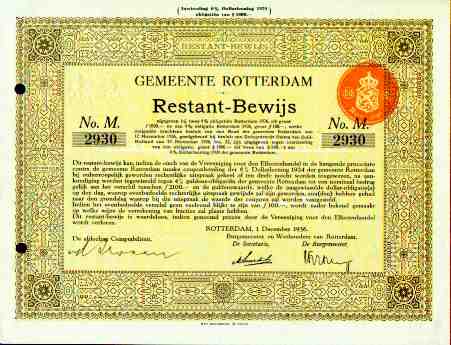
Gemeente Rotterdam, Restantbewijs bij obligatie, 1-12-1936,
bruine muzieknotensierrand op geel veld; Eng: brown
music note type decorative border, on yellow field, see picture, orange tax stamp, EF,
but
in left border 2 small ordner holes, unfolded, municipal armour in
relief
seal;
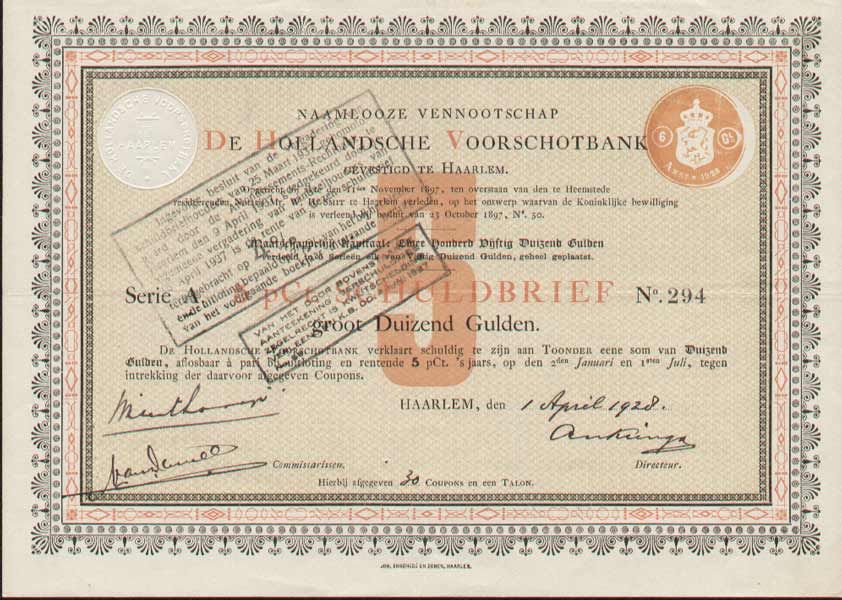
De Hollandsche Voorschotbank, NV
Gevestigd te Haarlem (NH); druk Johan Enschede en Zonen, Haarlem.
----- 6% schuldbrief groot f 100, serie C, 1922; fraaie zwarte sierrand met muzieknotenschrift in groen, oranje bel. stempel;
VF: 2 archiefgaten, 3 gaten als ontwaarding door drie originele handtekeningen, afm. ca. 25 x 18 cm.; 2 grote stempels: de coupon is in 1937 verlaagd naar 4%; met verklaring rechtsherstel, prijs 75 €.
----- 5% schuldbrief, serie A, 1928, fraaie zwarte sierrand met muzieknotenschrift in oranje, oranje bel. stempel; afm. ca. 25 x 18 cm.; EF: 1 lichte vouw; 2 grote stempels: de coupon is in 1937 verlaagd naar 4%; geen coupons, noch verkl. rechtsherstel; prijs 95 €.
 |
|
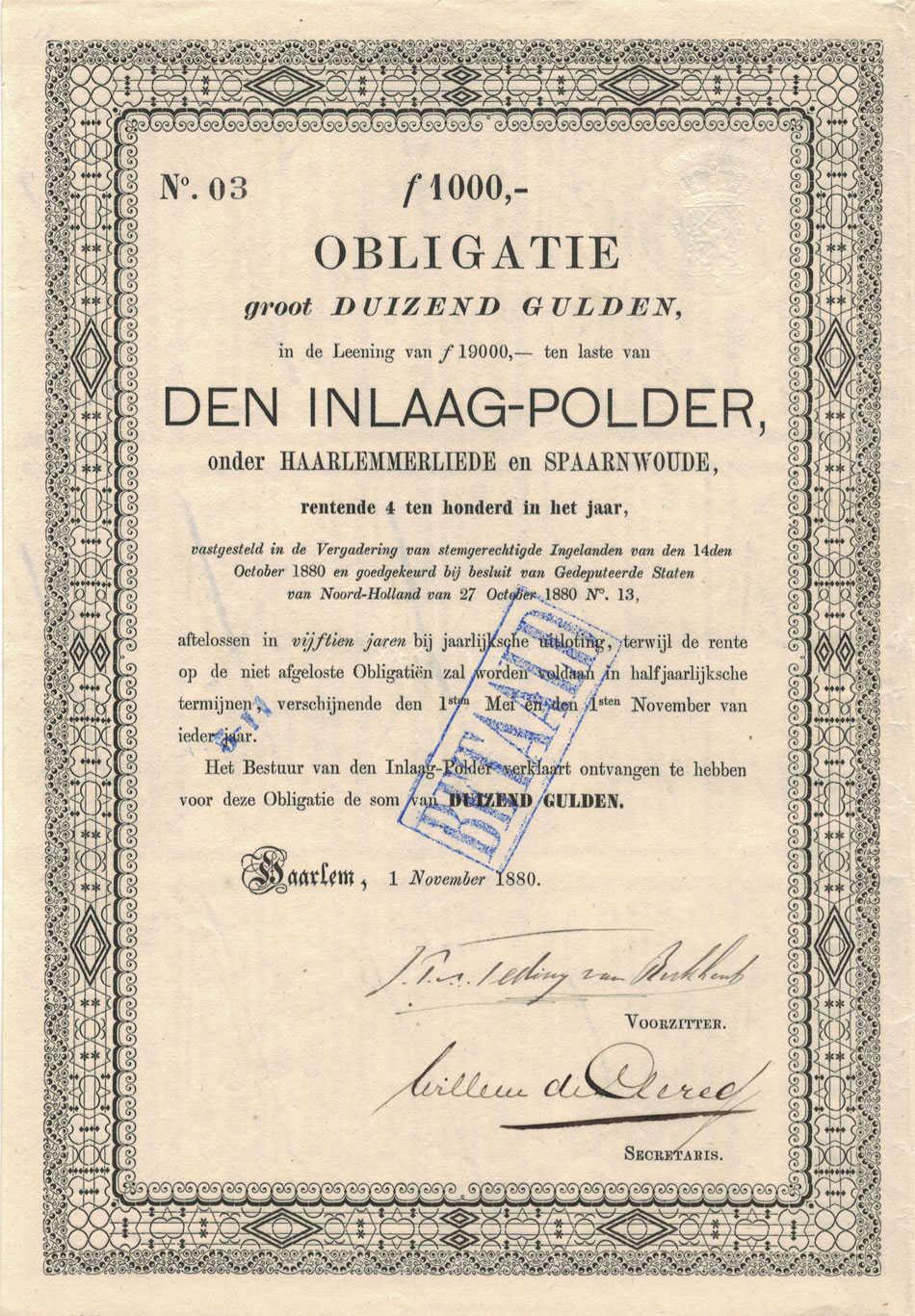
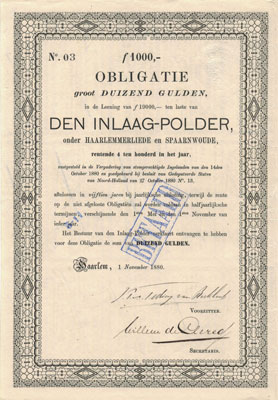
Den Inlaag-Polder onder Haarlemmerliede en Spaarnwoude, 1880
4% obligatie f 1000,
no. 15 in leening f 19.000 (dus oplage slechts
19 stuks !),
vastgesteld in de vergadering van stemgerechtigde
Ingelanden van den 14den October 1880 en goedgekeurd bij besluit van Gedeputeerde
Staten van Noord-Holland van 27 October 1880 No. 13. Af te lossen in 15 jaren
bij jaarlijkse uitloting. Halfjaarlijkse rentetermijnen.
De aanhangende coupons
zijn geknipt t/m mei 1887. Afm. ca. 16,8 x 24,2 cm. Gepreegd blank belastingzegel, fraaie sierrand in muzieknotenschrift.
----- no. 13, conditie VF: 1 middenvouw, 2 speldenprikken en 3 kleine ontwaardingsgaatjes in de handtekeningen, prijs € 85
----- no. 14, conditie VF, lichte vouwen, ontwaardingsgaatjes door het gepreegd belastongzegel en door elke handtekening, iets bruin in linker boven- en onderhoek, prijs € 75 |
Inlaagpolder
Politieverordening uit 2011, 11 blzn, in drukfrisse staat, prijs € 15
Zie het kaft, blz. 1 en de slotbepalingen.
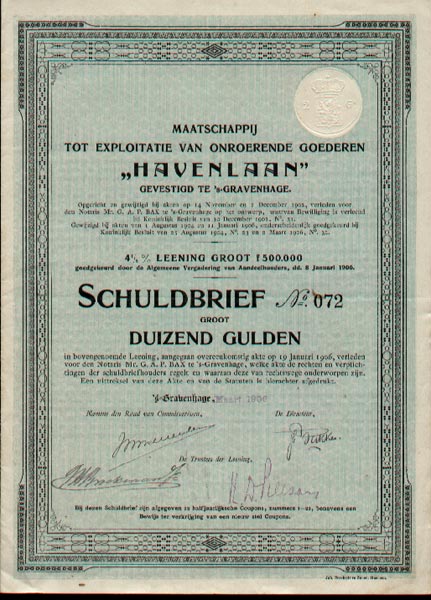
Maatschappij tot exploitatie van onroerende goederen "Havenlaan",
gev. te 's Gravenhage; opgericht 1906; 4,5% schuldbrief, no 72, groot f
1000; 's Gravenhage 1906; zwarte sierrand van muzieknotenschrift op
groen veld; 18 bij 25 cm.; druk: Joh. Enschede en Zonen, Haarlem; 4
origin. handtekeningen; blanco gepreegd belastingzegel; div. losse
coupons en talons; kleine roestsporen op voorkant en sterkere op
binnenkant; 45 Euro.
NV Nederlandsche Maatschappij voor Kunstmatige Oesterteelt voorheen
de Firma C.L. De Meulemeester & Co. te Bergen op Zoom (N.Br.),
(Haar juridische navolger, het beursgenoteerde
Meulenmeester Oesterteelt, trok aandeelhouders naar de jaarvergadering
met een gratis maal oesters !; bron: Willem van den Boom, RABO-Bank
Holten)
---------- Bewijs van winstaandeel, mei 1892, orig. handt., zwarte muzieknotenschrift rand op
rose patroon, druk: Joh. Enschede en zonen, Haarlem, blauw
belastingstempel noord Holland, 24 bij 17 cm, see
picture, 95 Euro.
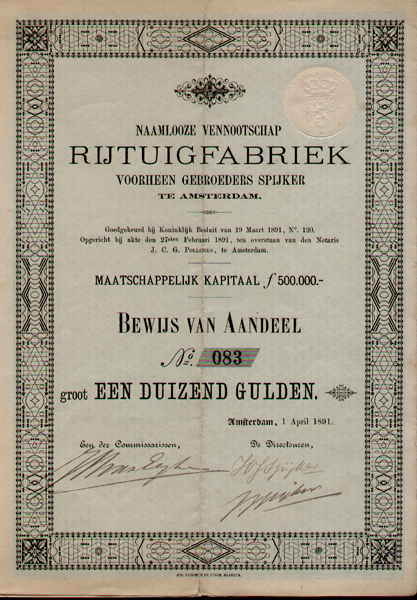
NV Rijtuigfabriek voorheen gebroeders Spijker (Engl.: Carriage-works formerly Spijker brothers)
Amsterdam, April 1st 1891; Bewijs van aandeel (Engl.: Certificate of one share) no. 083, groot f 1000 (thousand guilders) in a total kapital of f 500.000. The company was established in february 27th 1891.
Originally signed by the 2 directors H.J. (Hendrik Jan) Spijker and J. (Jacobus) Spijker as well as by board member van Eeghen.
Printed by Joh. Enschede en zonen, Haarlem. Light green with a decorative "music note" type border and an embossed tax seal from the province of North Holland.
Condition VF: one midfold, torn below 2 cm. and above 0,5 cm. Attached is the coupon sheet, 6 of which have been declared for dividend.
This share is the second one that has ever appeared on the collector's market. The first one (no. 079) was auctioned in 2001 by Monen in The Netherlands and fetched a price of 7,300 Duth Guilders, including charges Dutch Guilders 9,037. Because of the listing of Spyker Cars on the Amsterdam Stock Exchange on May 27th 2004 and the participation of Spyker Cars in Formula-1 racing, Spyker has - again - become a world wide famous brand by now.
Short history of this company and its follower, the currently active and famous Spyker automobielfabrieken (Spyker cars):
(click here for the more comprehensive story)
In 1880 the Spijker brothers started a coach and carriage factory in Hilversum. In 1886 they moved to the Stadhouderskade in Amsterdam, where they started producing automobiles around 1900. One of the last coaches they produced is the famous Golden Coach, a present to Queen Wilhelmina from the city of Amsterdam, on the occasion of her ascent to the throne in 1898. This coach is still in use by the present queen every year at the opening of parliament.
In 1901 the Spijker brothers started to build Benz cars in licence under the name Spijker-Benz. For this purpose a new factory was built at the Amsteldijk in Amsterdam with the name Industriële Maatschappij Trompenburg, after the former homestead at that location (These offices and factory are shown on the paper factory Nestelrooy that used these buildings in the period after 1925, when the car factory closed down). In 1903 the name Spijker was changed into Spyker, easier for use abroad. In that year they built a car that was both the first 6-cylinder as well the first permanently 4-wheel driven car in the world, the 60 HP GrandPrix racer. This car still exists and can be seen in the Automobiel museum in Raamsdonksveer. In 1907 the Spyker 14/18 finished in the first Peking-Paris rally. The brand became world famous and was called the Rolls Royce of the continent. In 1914 Spyker merged with the Dutch Aircraft Factory N.V. and the axiom became: "Nulla Tenaci invia est via" (for the tenacious no road is impassable). The logo became a combination of a spiked wheel and an airoplane propellor. In 1915 de airplane pilot Henri Wijnmaken became director until 1922. During the first world war 100 fighter-planes and 200 aircraft engines were produced by what was now "the NV Nederlandsche Automobiel- en Vliegtuigfabriek "Trompenburg" (the Dutch Automobile and Airplane works Trompenburg". A few shares of this company from 1916 exist in the collector's market. Trompenburg went not broke but had to stop the production in 1925. On May 26th 1926 the inventory was auctioned. The company had produced 1500 cars and held more than 100 patents in its name.
Spyker Cars
Many years later, he rights for the name Spyker were bought for Spyker Cars (at that time Spyker Automobielen BV), founded in1999 by entrepeneur Victor Muller and co-founder and car designer Maarten de Bruijn. In 2000 the Spyker C8 Spyder was introduced, 75 years after the last Spyker had been built in 1925. This hand made car reflects in its design the combined car-airoplane history to a large extent. On May 27th 2004 Spyker Cars became listed under that name on the Amsterdam Stock Exchange. In that year three models were being hand made in the works at Zeewolde: the Spyder 215, Laviolette and Double 12. In 2002 and 2003 they participated in the 24 hours race at Le Mans. In 2006 some 100 cars were produced. In 2007 production stalled to about a quarter of that and the company faced severe financial and other difficulties. Therefore the Formula-1 racing team was sold in september 2007 to the Indian entrepeneur Vijay Mallya and the Dutch family de Mol for € 88 million. Besides that, the Russian banker Vladimir Antonov is going to give a financial injection of another € 34,5 million through Snoras Bank in Litauen, part of the Russian Convers Group that is controlled by Antonov.

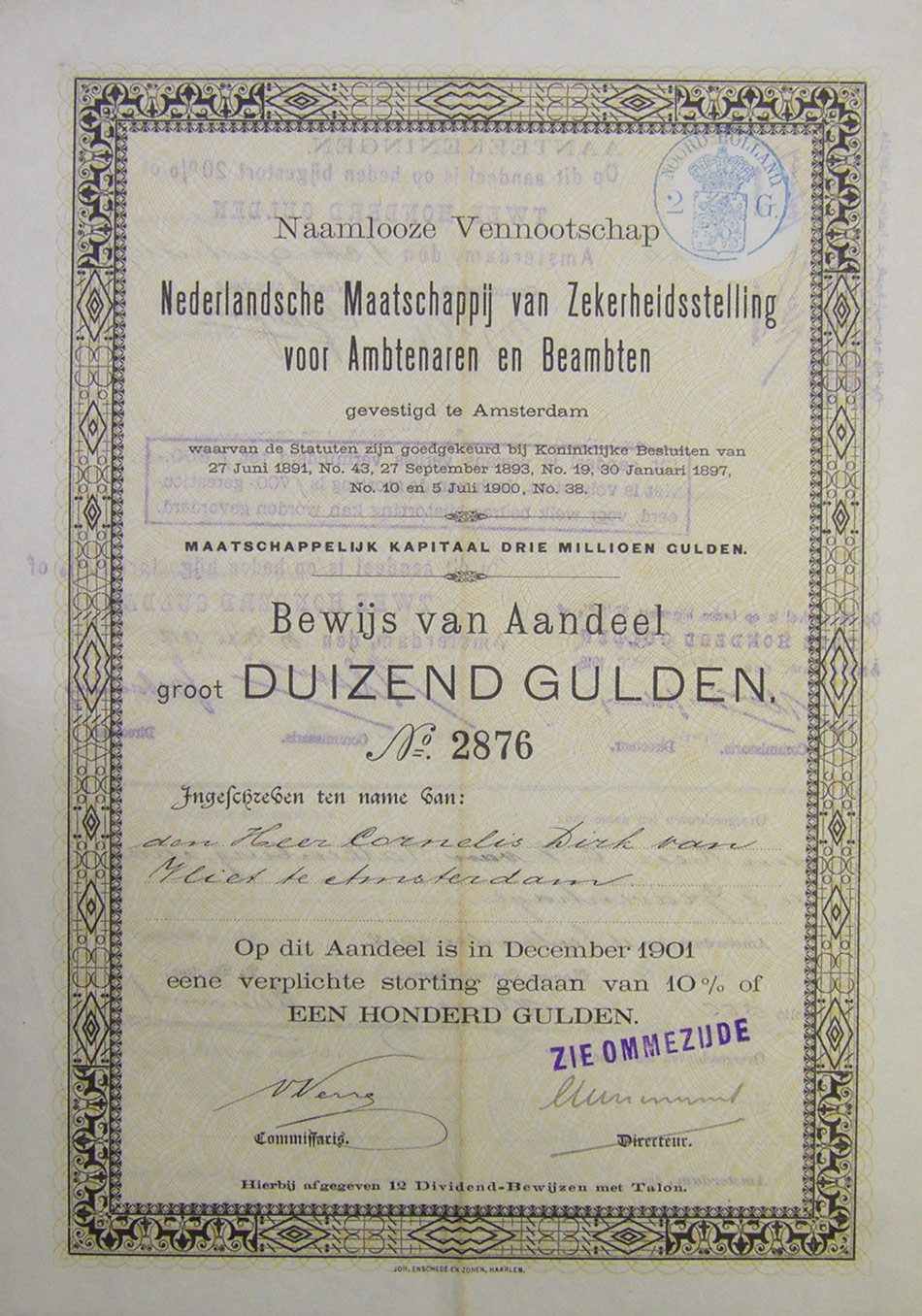
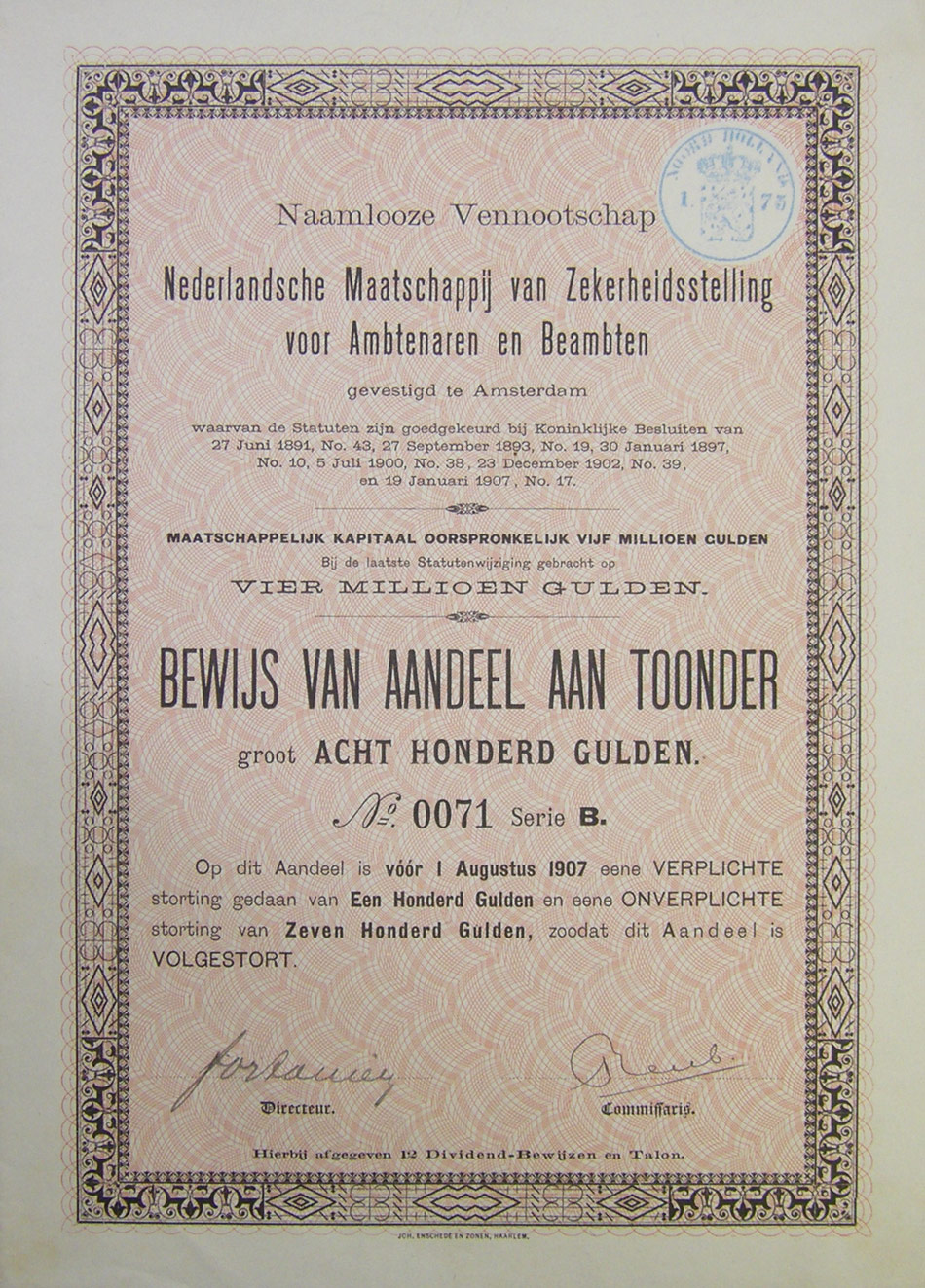
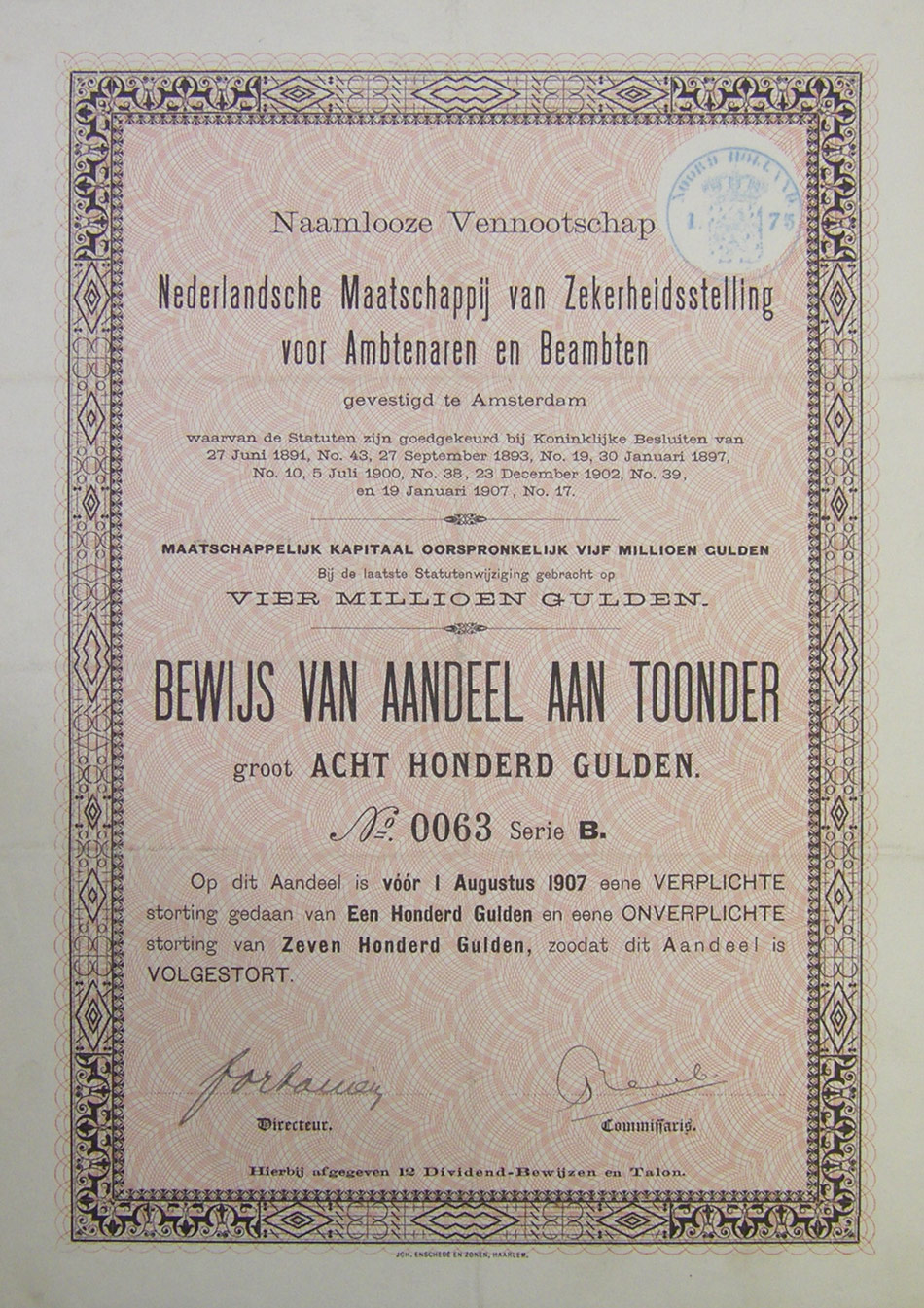
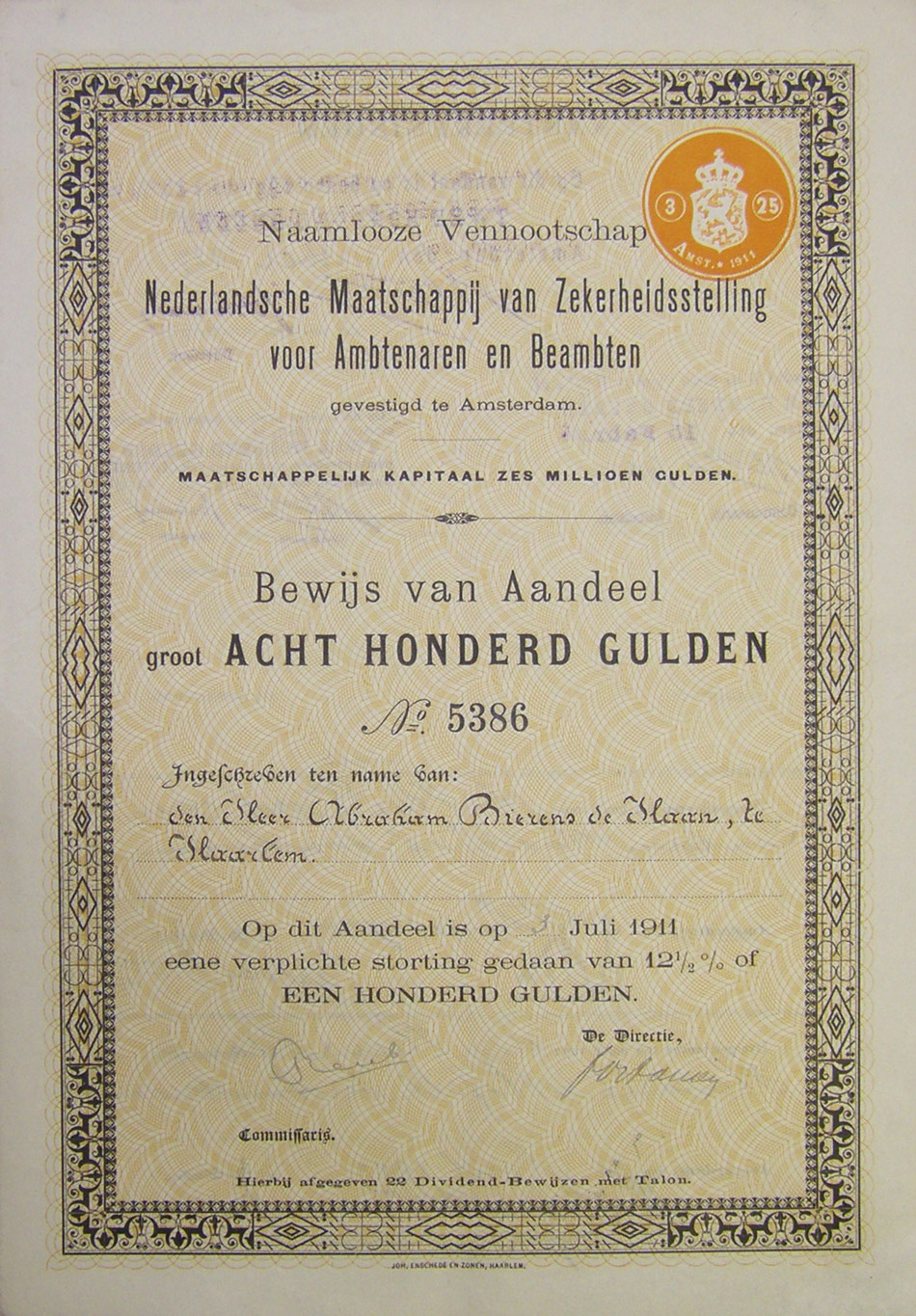
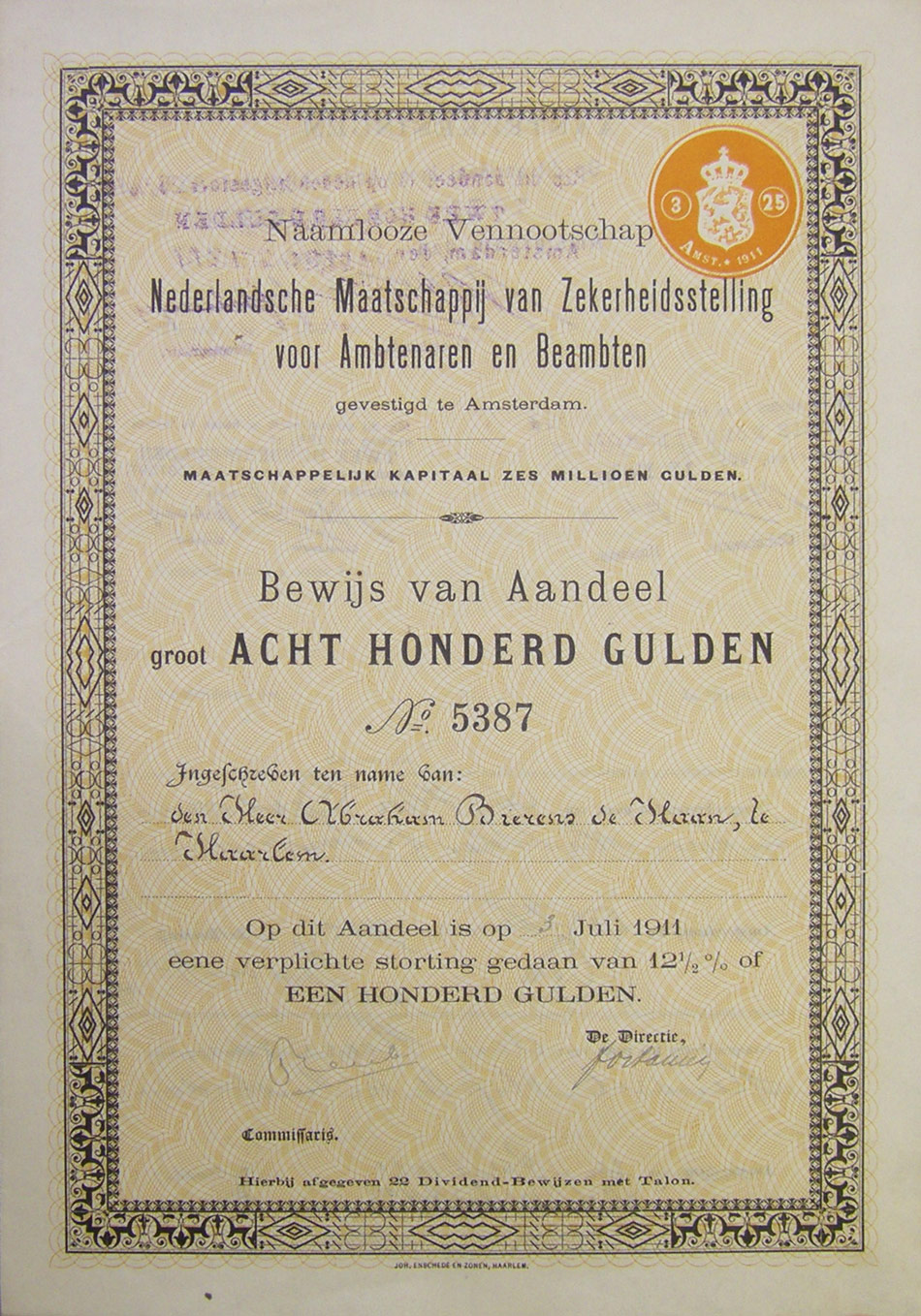
Nederlandsche Maatschappij van Zekerheidsstelling voor Ambtenaren
en Beambten, NV
(Eng: company for assurance for civil servants),
gev. te
Amsterdam, opgericht 27-6-1891. afmeting: ca. 18 x 26 cm., Sierand van het bekende muzieknotenschrift van de
drukker Joh. Enschede en Zonen, Haarlem (Engl: decorative border from so
called "music notes", a safe
printing method originally used for bank notes). Volgens W.J.
Nieboer (VVOF Mededelingenblad maart 1996, p. 6-8 en 13, kan de maatschappij
worden beschouwd als een voorloper van de huidige pensioenfondsen. Hij
schrijft dat het de firma slecht verging en dat vele beambten in die
jaren hun pensioen in een faillissement zagen opgaan.
English: The
copany was a forerunner of the modern pension funds for civil servants.
In this case
it seems that the savings were lost in a bankruptcy.
----- 1897, licht geel veld; Maatsch. Kapitaal f 2 miljoen, Bewijs van aandeel f 1000, t.n.v. Mejuffrouw Adriana Magdalena van Haaften te 's Gravenhag, met aanh. achterblad en los couponblad met coupons no. 33 e.v.; in 1907 overgeschreven t.n.v. Frans van Manen te Utrecht, in 1921 t.n.v. Dirk van Lankeren Matthes te Amsterdam en in 1923 t.n.v. adam Hendrik Alsfeld te Amsterdam;
---------- no. 1308, in heel mooie EF conditie, prijs € 50.
---------- no. 1307, in mooie VF + conditie, prijs € 35.
----- 1901, licht geel veld; Maatsch. Kapitaal 3 mln, bewijs van aandeel f 1000, no. 2876, t.n.v. dhr.
Cornelis Dirk van Vliet te Amsterdam, in 1912 overgeschreven t.n.v.
C. V. van Valkenburg,
arts te 's Gravenhage, origin. handt. + couponblad met no's 33 e.v.; , blauw
belastingstempel, prijs € 50.mooie VF + conditie.
---- 1907, rose veld; Maatsch. Kapitaal f 4 miljoen, aandeel aan toonder, f 800, blauw belastingstempel:
----------- Serie B no. 0071, heel mooie EF conditie, 1 losse talon, geen couponblad, prijs 35 Euro.
----------- Serie B no 0063, mooie conditie VF +, geen couponblad, prijs 25 Euro.
----- 1911, geel veld, oranje gedrukt belastingzegel f 3,25; los couponblad met no 33 e.v. Bewijs van Aandeel f 800, no's 5385, 86, 87 en 88, t.n.v. Abraham Bierens de Haan te Haarlem, in 1922 overgeschreven t.n.v. Dirk van Lankeren te A'dam en in 1923 t.n.v. Adam Hendrik Alsfelt te A'dam, conditie VF +: slechts onzichtbaar gevouwen, maar stempels op de achterkant schijnen wat door op het voorblad, prijs € 20 / st.
Suikerfabriek "Bodjong"
Gev. te Amsterdam, opgericht in 1910
---------- Bewijs van aandeel groot f 1000, no. 0336, Amsterdam, 1911, afm. ca. 22 x 35 cm., fraaie bruine rand van muzieknotenschrift op lichtgroen veld, met los couponblad waarvan 27 geknipt, conditie VF, diverse gebruikssporen, de randen lijken door het fotograferen wat ongelijk, maar alle randen zijn helemaal aanwezig; prijs € 25
The factory was located in Poerbolingo in the residence of Banjoemas on the isle of Java, Dutch East Indies. From 1920 onward the Nederlandsch Administratie- en Trustkantoor (Dutch Administration and Trust Office) has issued share certificates of 100 Guilders. The company was dissolved in 1935 because of too low sugar prices. Source: V.V.O.F Mededelingenblad no3, september 1982, p. 16-17.
Dr. Hugo H. van der Molen -
Tel: +31 (0)50 534 8795; email: [email protected]
en Facebook of Linkedin
See
page on explanations, sales conditions, costs of shipping and on how
to
order and to pay.
You are here: home - scripophily
- muzieknotenschrift